
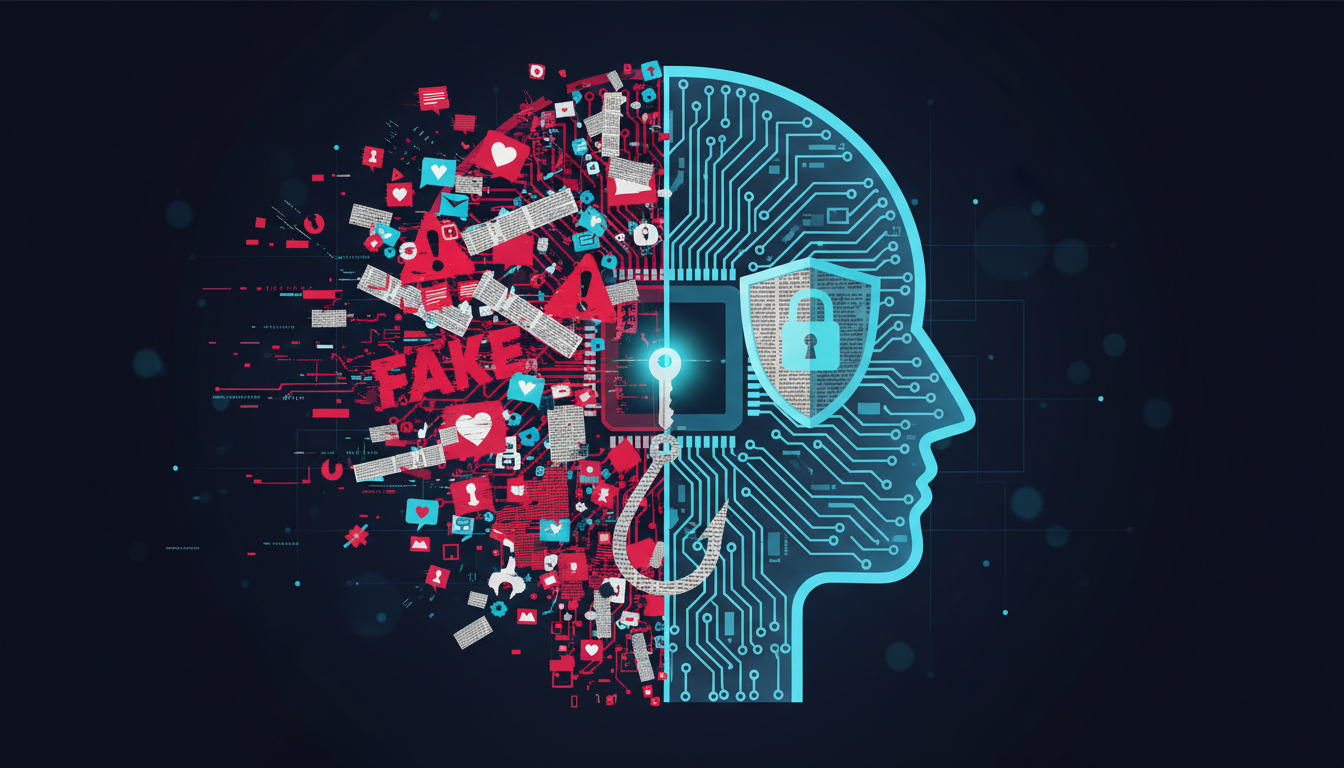
In today’s hyperconnected world, cyber threats no longer arrive only as lines of malicious code or shadowy malware hidden in downloads. Increasingly, they come wrapped in headlines, hashtags, and viral posts. Fake news and misinformation campaigns have quietly become one of the most effective weapons in the modern cyber threat landscape—and their impact on cybersecurity is deeper and more dangerous than many realise.
When Information Becomes an Attack Vector
Cybersecurity traditionally focuses on protecting systems, networks, and data. But misinformation targets something far more unpredictable: human behaviour.
A well-crafted fake news story can spread faster than a zero-day exploit. It exploits trust, fear, and curiosity—emotions that often take precedence over logic. When users click on a sensational headline, share an alarming post, or act on false information, they often unknowingly open the door to phishing attacks, malware infections, or data leaks.
In this sense, misinformation itself becomes an attack vector. The keyboard isn’t always the entry point—the mind is.
Social Engineering at Internet Scale
Fake news campaigns are essentially social engineering operations amplified by the internet. Instead of targeting one employee with a phishing email, attackers can target millions at once using social media, messaging platforms, and fake news websites.
Consider these scenarios:
- A viral post warns of a “new government cybersecurity policy” and links to a fake login page.
- A breaking-news-style article claims a major platform has been hacked, urging users to “verify” their accounts immediately.
- A fake crisis sparks panic, driving people to download malicious “security tools” or apps.
These campaigns blur the line between disinformation and cybercrime. The goal is no longer just to mislead—it’s to manipulate users into compromising their own security.
Eroding Trust in Digital Systems
One of the most damaging effects of fake news is its ability to erode trust. When people can’t distinguish between legitimate security alerts and fabricated ones, they begin to ignore both.
This creates a dangerous paradox:
- Real warnings are dismissed as “just another hoax.”
- Fake alerts appear believable because they closely resemble the real thing.
Over time, this erosion of trust weakens the effectiveness of genuine cybersecurity communication—from software updates to breach notifications. Attackers thrive in this confusion.
Nation-State Campaigns and Cyber Warfare
At a larger scale, misinformation is now a recognised component of cyber warfare. Nation-state actors use fake news to destabilise societies, influence public opinion, and distract from or support cyber operations.
A coordinated misinformation campaign can:
- Mask an ongoing cyberattack
- Shift blame after a data breach
- Undermine confidence in critical infrastructure like elections, healthcare systems, or financial institutions
In these cases, fake news isn’t just a side effect of cyber conflict—it’s part of the strategy.
The Human Firewall Is Under Pressure
Organisations often talk about the “human firewall”—employees trained to recognise threats and act securely. Misinformation campaigns put that firewall under constant pressure.
Even well-trained users can be overwhelmed by:
- Information overload
- Conflicting narratives
- Highly realistic fake content, including AI-generated text, images, and videos
When misinformation is persistent and emotionally charged, awareness training alone is no longer enough. Cybersecurity must adapt to this new psychological battlefield.
Fighting Back: Cybersecurity Meets Media Literacy
Defending against fake news-driven cyber threats requires a broader approach:
- Cybersecurity teams must monitor misinformation trends as potential threat indicators.
- Organisations need clear, trusted communication channels so users know where real alerts come from.
- Individuals must develop media literacy skills alongside basic cyber hygiene.
The future of cybersecurity isn’t just about stronger encryption or smarter firewalls—it’s about understanding how information spreads, how trust is built, and how easily both can be weaponised.
Final Thoughts
Fake news and misinformation campaigns have transformed cybersecurity from a purely technical discipline into a human-centric challenge. They remind us that the weakest link in security is not the software—it’s perception.
As long as attackers can manipulate what we believe, they can influence what we click, share, and download. In this new reality, defending cyberspace means defending truth itself.
Welcome to the age where information is both the shield and the sword—and cybersecurity depends on knowing the difference.
Leave a Reply