
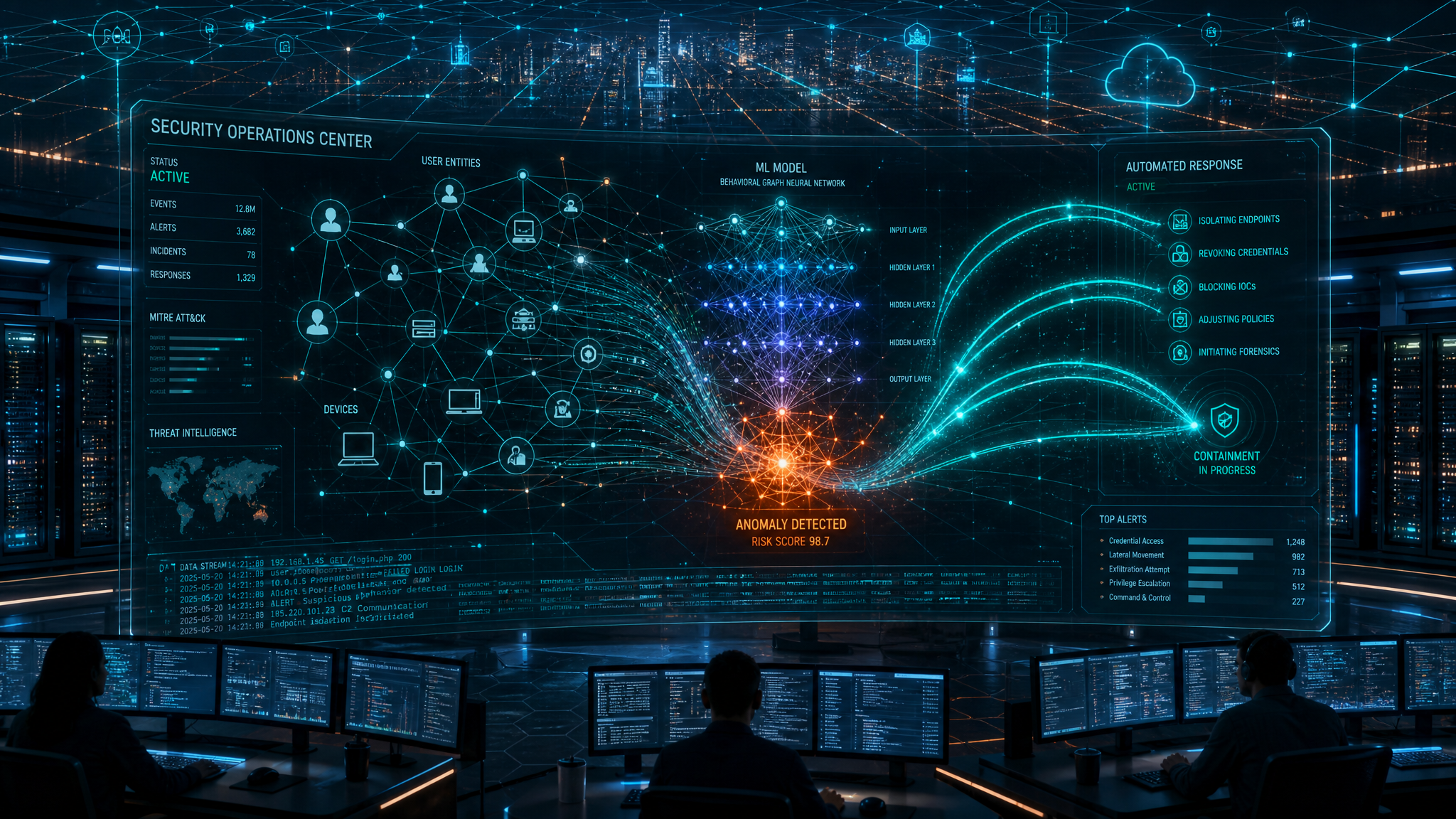
Cyber threats don’t behave like they used to. Attackers move faster, blend into legitimate traffic, and adapt the moment defenders publish new indicators. In this environment, security teams face a brutal mismatch: the volume of events is exploding, but human attention—and time—are fixed.

Machine learning (ML) has become compelling in threat detection not because it “solves security,” but because it changes the economics of defence. Instead of relying solely on hand-written rules and known-bad signatures, ML systems can identify subtle patterns, shift with evolving behaviour, and help analysts focus on the few events that truly matter.
This article explores what ML brings to threat detection, where it shines, where it breaks, and how organisations can use it responsibly to improve detection and response.
Why Traditional Detection Struggles
Classic security detection largely depends on:
- Signatures (known malware hashes, known malicious domains, known exploit patterns)
- Static rules (if-then logic built from past incidents)
- Threshold alerts (e.g., “more than X failed logins”)
These are still essential. But they’re increasingly insufficient on their own because
- Threats mutate quickly (polymorphic malware, living-off-the-land techniques).
- Attackers “look normal” by abusing legitimate tools (PowerShell, cloud consoles, VPNs).
- Environments change constantly (remote work, SaaS sprawl, ephemeral cloud infrastructure).
- Noise overwhelms teams (alert fatigue is a chronic operational risk).
When the adversary hides inside normal behaviour, rules alone tend to either miss the threat or flood the SOC with false positives.
What Machine Learning Adds (and Why It Matters)
ML-based detection is best understood as a set of capabilities that complement existing controls.
1) Behavioural Detection Instead of “Known Bad”
Rather than asking “Have we seen this exact indicator before?”, ML can ask:
- Is this authentication behaviour atypical for this user?
- Is this process execution chain unusual for this endpoint?
- Is this data access pattern abnormal for this service account?
That shift is crucial for detecting:
- Credential theft and account takeover
- Insider threats
- Lateral movement
- New malware families
- Cloud misuse (suspicious IAM behaviour, unusual API call sequences)
2) Anomaly Detection for the Unknown Unknowns
A major promise of ML is finding things you didn’t think to write rules for.
Unsupervised and semi-supervised approaches can model “normal” and surface deviations, such as the following:
- A workstation beaconing periodically to a rare domain
- A database account is downloading far more records than usual
- A privileged role being assumed at unusual times, from unusual locations
Anomaly detection is powerful—but it must be paired with context, or it becomes an “everything is weird” machine.
3) Better Prioritisation (Reducing Alert Fatigue)
Many security organisations don’t primarily need “more detection.” They need better triage.
ML can assist by:
- Scoring alerts based on likelihood and potential impact
- Correlating weak signals into stronger incident narratives
- Grouping similar alerts to reduce duplicates
- Learning from outcomes (e.g., what analysts close vs. escalate)
This is where ML often delivers real operational ROI: it helps teams spend time on high-value investigations instead of chasing endless low-confidence pings.
4) Pattern Recognition at Machine Scale
Threat detection isn’t just about spotting one event—it’s about connecting sequences:
- Phishing email → suspicious login → token creation → mailbox rules → exfiltration
- New process → unusual network connection → privilege escalation attempt → persistence mechanism
ML can support this by modelling relationships across the following:
- Users, devices, IPs, domains, processes
- Time series patterns (what happens before/after)
- Graph structures (who touched what, when)
When done well, it moves detection toward “story-based security,” not isolated alerts.
Common ML Techniques Used in Threat Detection
You don’t need a PhD to understand the broad categories:
- Supervised learning: Trained on labelled examples (malicious/benign). Great when labels are high quality—hard when they aren’t.
- Unsupervised learning: Finds clusters/anomalies without labels. Useful for novelty—prone to false positives without context.
- Semi-supervised learning: Learns “normal” from mostly benign data; flags deviations.
- NLP (Natural Language Processing): Analyses emails, URLs, logs, tickets, and narratives—useful in phishing detection and log enrichment.
- Graph-based methods: Model relationships (e.g., identity-to-resource access). Excellent for fraud-like patterns and lateral movement.
In practice, mature systems combine several techniques with strong engineering around data pipelines and feedback loops.
Where ML Works Best (Realistic Use Cases)
ML tends to be most valuable in domains where behaviour is complex and high volume:
- Phishing and email security
- Detecting suspicious language patterns, sender anomalies, and link obfuscation tactics
- Identity and access threat detection
- Impossible travel, unusual device posture, abnormal privilege escalation
- Endpoint detection
- Rare process trees, suspicious parent-child execution chains
- Network detection
- Beaconing, DNS tunnelling signals, and lateral movement patterns
- Cloud threat detection
- Anomalous API usage, risky permission changes, suspicious role assumptions
These are areas where attackers intentionally mimic legitimate activity—exactly where ML’s pattern sensitivity can help.
The Hard Truths: Limitations and Risks
ML is not magic. In security, it can fail loudly if deployed without guardrails.
1) False Positives and “Anomaly Spam”
If “normal” is poorly defined—because the environment is changing or the model lacks context—everything becomes an anomaly. That’s not detection; it’s distraction.
2) Data Quality Determines Model Quality
ML systems reflect the data they ingest. Common problems include:
- Incomplete logs
- Inconsistent schemas
- Poor identity resolution (who is “user123” across systems?)
- Missing ground-truth labels
- Over-reliance on vendor default telemetry
Security ML is less about clever algorithms and more about disciplined data engineering.
3) Adversarial Adaptation
Attackers can adapt to models by:
- “Low and slow” behaviour to avoid anomalies
- Mimicking typical user patterns
- Poisoning data in some contexts (less common, but real in certain pipelines)
Defenders must treat ML detections as evolving controls, not set-and-forget features.
4) Explainability and Trust
SOC teams need to know why something was flagged. If the output is a black-box score with no supporting evidence, analysts can’t act confidently.
Strong ML detection systems provide:
- Key contributing signals (features)
- Comparable historical baselines
- Related events and entities
- Clear investigative next steps
What “Good” Looks Like: ML as a Detection System, Not a Model
Organisations get the most value from ML when they treat it as part of an end-to-end detection and response workflow:
- Instrument the environment (high-quality telemetry, consistent identity)
- Normalise + enrich data (asset criticality, user roles, threat intel, context)
- Detect and score (ML + rules + signatures working together)
- Correlate into incidents (reduce noise, build narratives)
- Close the loop (analyst feedback improves tuning and training)
- Measure outcomes (MTTD/MTTR, false positive rates, coverage gaps)
This is how ML becomes a force multiplier rather than a science project.
The Future: ML + Automation + Human Judgment
Threat detection is trending toward hybrid intelligence:
- ML surfaces and prioritises risk
- Automation handles repetitive containment and enrichment
- Humans make high-stakes decisions, handle ambiguity, and improve strategy
The best security programs won’t be the ones that “use ML.” They’ll be the ones that build a system where ML makes defenders faster, calmer, and more consistent under pressure.
Machine learning’s role in threat detection is ultimately pragmatic: it helps security teams detect more of what matters sooner—and spend less time drowning in what doesn’t.
Leave a Reply